On August 5, 2026, the Committee on Foreign Investment in the United States (CFIUS) released its Annual Report to Congress for Calendar Year 2025 (the Report), which highlights CFIUS priorities, enforcement trends, and key indicators of CFIUS processes and statistics on transactions filed in calendar year 2025. The Report provides valuable information for companies, private equity funds, and investors evaluating foreign investments in US businesses. While there are some important changes reflected in the data — such as a shift to more declarations and an increase in the withdraw-and-refile rate — the data is largely consistent with CFIUS reports from recent years, which suggests the thrust of CFIUS operations and outcomes has continued without major changes across administrations.
This Client Alert presents six key takeaways from the Report.
1. CFIUS Filings Rebounded Modestly as Declarations Outpaced Notices
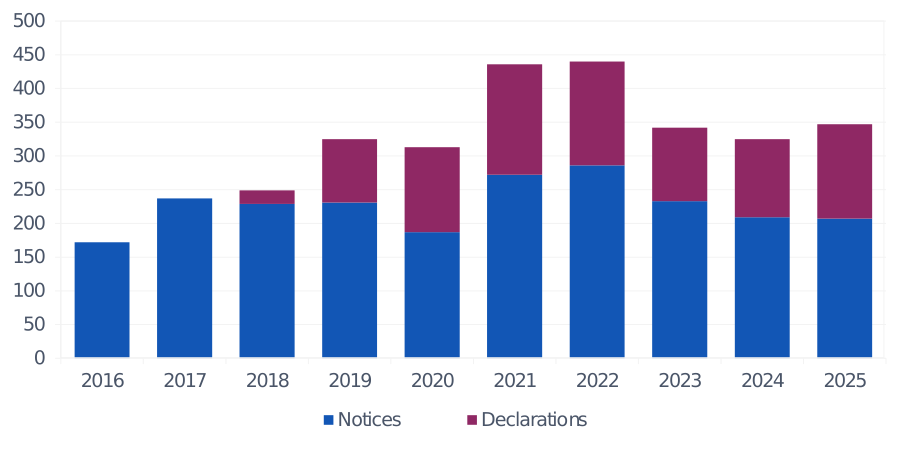
CFIUS reviewed 347 covered transactions in 2025, a modest 7% increase from 325 in 2024, but still well below the 2022 peak of 440. The rebound was driven entirely by declarations, which rose from 116 to 140, while full notices essentially held, falling from 209 to 207. This represents the first increase in overall filings since 2022 and also tracks a 2025 increase of approximately 50% (or a rise of about $76 billion) in foreign direct investment into the United States over 2024 levels, which stood at $151 billion, according to the US Bureau of Economic Analysis.
Parties appear to be using the short-form declaration increasingly as a first step, gauging whether CFIUS will clear the transaction before committing to the more resource-intensive notice process. As discussed below, that strategy now carries greater risk of a notice request, and parties should weigh carefully whether starting with a declaration will save time or could result in a longer process if CFIUS requests a full notice after the declaration’s 30-day assessment period.
Based on recently assigned case numbers, as of early August 2026, CFIUS filings appear to be slightly ahead of 2026 with respect to full notices (151) and slightly behind with respect to declarations (70).
CFIUS Filings Received
2. Declarations Surged but CFIUS Requested More Full Notices
The declaration clearance rate fell sharply in 2025, from 78% to 66%. Declarations resulting in a request for a full notice more than doubled from 17 to 36 (see table below). As a share of declarations, notice requests rose from 15% to 26%. More than one-third of those filing declarations either received a request to file a full notice or a no-action letter (i.e., a “shoulder shrug” that does not provide the benefit of safe harbor), making declarations a less reliable path to clearance than in prior years.
In addition, 36% of declarations submitted in 2025 (51 of 140) were subject to mandatory filing requirements. Companies involved in critical technologies, covered investment critical infrastructure, or sensitive personal data should evaluate early whether their transaction would trigger a mandatory obligation. This is particularly important given that CFIUS issued two formal noncompliance determinations in 2025 with respect to its mandatory filing requirements. Even where a declaration satisfies the mandatory filing requirement, parties should consider whether the risk profile of the transaction warrants filing a full notice to avoid the protracted two-step process of having to file a full notice after the declaration’s 30-day assessment period.
CFIUS Assessment of Declarations
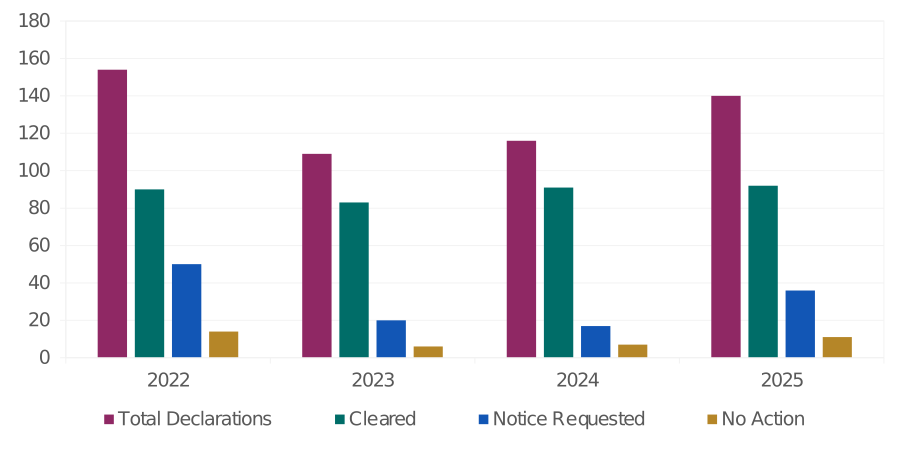
CFIUS Assessment of Declarations
|
Year
|
Total Declarations
|
Cleared
|
Notice Requested
|
No Action
|
|
2022
|
154
|
90 (58%)
|
50 (33%)
|
14 (9%)
|
|
2023
|
109
|
83 (76%)
|
20 (18%)
|
6 (6%)
|
|
2024
|
116
|
91 (78%)
|
17 (15%)
|
7 (6%)
|
|
2025
|
140
|
92 (66%)
|
36 (26%)
|
11 (8%)
|
3. China Reclaimed the Top Spot for Notices While Japan Led Declarations
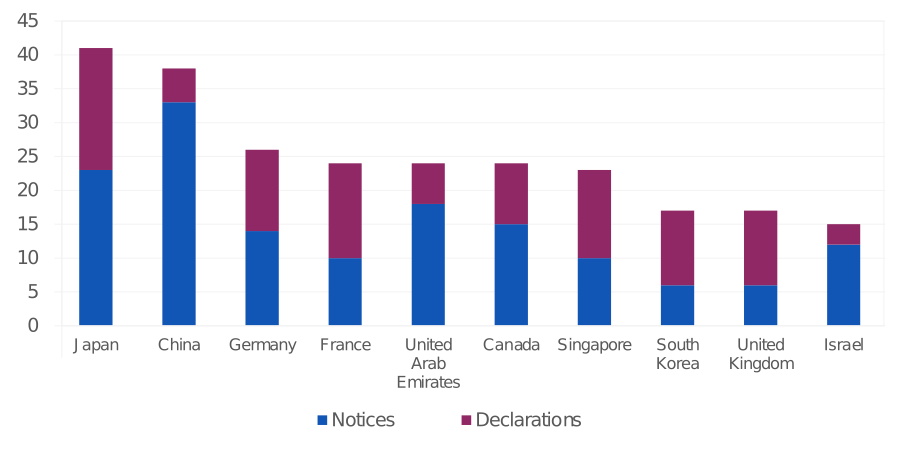
CFIUS filings spanned investors from more than 40 countries in 2025.
China reclaimed the top position for notice filings (33 notices, 17% of total) despite filing only five declarations, while Japan led declarations (18) and was second for notices (23), making it the top overall filer with 41 filings, without taking into account declarations that resulted in a full notice or withdrawn-and-refiled cases. The data indicates a gap between China’s notice count and its transaction count, suggesting a meaningful share of Chinese notices represent withdrawn-and-refiled cases with protracted reviews, rather than any surge in the filing of unique transactions from Chinese investors. For parties involved in transactions with an investor from China, this data reinforces the importance of building extended timelines, preparing for second-stage investigations, and engaging with CFIUS early on mitigation expectations.
By contrast, allied and partner nations relied heavily on declarations. France (14), Singapore (13), Germany (12), South Korea (11), and the United Kingdom (11) were the top declaration filers. India surged from zero declarations in 2024 to six in 2025, while Singapore more than doubled from five to 13. For investors from these countries, the declaration remains a viable and often efficient filing path, particularly for transactions that do not implicate critical technologies or sensitive sectors.
Israel continued to climb in notice filings (eight in 2023, 10 in 2024, and 12 in 2025) and was the third most active country for critical technology acquisitions (15 transactions). Although Israel is a close US ally, transactions involving Israeli investors in defense-adjacent or dual-use technology sectors may still attract close scrutiny.
CFIUS Filings by Top Investor Countries
4. Compounding Timeline Uncertainty: Shutdowns, Refiles, and Investigation Extensions
Three independent sources of delay converged in 2025 to create the longest and least predictable CFIUS timelines in the program’s history. The withdraw-and-refile rate climbed to 25% (51 of 207 notices), an increase over 2024 when 20% of all notices were withdrawn and refiled, as well as 2023 when the rate fell to 18%. Investigation extensions for “extraordinary circumstances” rose from just one in 2023, to two in 2024, and then to eight in 2025 — an eightfold increase over 2023 levels. And three separate government shutdowns tolled certain statutory deadlines for over 120 days in 2025 and early 2026, freezing pending cases without clear indications of when review would resume.
The three shutdowns resulted in serious disruptions for filers in 2025 and early 2026:
- First shutdown (October 1 – November 12, 2025): A 43-day lapse affecting all CFIUS member agencies
- Second shutdown (January 31 – February 3, 2026): A brief lapse affecting Department of the Treasury and several CFIUS member agencies
- Third (partial) shutdown (February 14 – April 30, 2026): A 75-day lapse affecting certain components of the Department of Homeland Security, a CFIUS member agency
Despite these disruptions, CFIUS reported that it cleared 67% of all covered transactions filed in 2025 within the initial assessment or review period (after excluding tolled days), and processing times net of tolled periods showed continued efficiency: draft notice comments averaged around five business days (improved from 6.5 in 2024 and eight in 2023), and formal notice acceptance averaged around three business days.
The increase in the withdraw-and-refile rate may indicate CFIUS’s substantive approach to complex transactions is requiring additional time or that administrative considerations have expanded the timeline. The 2023 Annual Report celebrated a refile rate of 18% as an efficiency gain from prior years. That improvement has been entirely erased: The rate rose to 20% in 2024 and 25% in 2025. Each refile resets the clock for a full 45-day review and, often, a subsequent 45-day investigation. In most instances, notices are withdrawn and refiled after CFIUS informs parties that the transaction poses a national security risk, and the parties request additional time to negotiate mitigation terms.
The investigation extension surge confirms that more cases are pushing against CFIUS’s statutory timing limits. The CFIUS authorizing statute, Section 721 of the Defense Production Act of 1950 (as amended), permits a single 15-day extension in “extraordinary circumstances,” a tool CFIUS historically used sparingly. The jump from one invocation in 2023 to eight in 2025 (7% of investigated cases) represents a sharp acceleration over recent years and signals that a growing share of transactions cannot be resolved within the standard statutory window even before accounting for refiles or shutdowns.
5. Non-Notified Investigations Continued but Formal Filing Requests Declined
CFIUS continued its active monitoring of non-notified transactions, though activity levels declined compared to 2024. In 2025, CFIUS:
- Identified “thousands” of potential non-notified transactions
- Investigated 90 transactions to determine which to open (down from 98 in 2024)
- Opened 62 official inquiries (down from 76 in 2024)
- Formally requested filings for nine transactions (down from 12 in 2024)
- Had two instances where parties voluntarily filed after receiving outreach (down from five in 2024)
The decline across all non-notified metrics is likely attributable in part to reduced CFIUS operational capacity during the government shutdowns. However, the conversion rate from official inquiry to formal filing request remained relatively stable at 15%, suggesting that CFIUS maintained its selectivity in determining which non-notified transactions warranted a formal filing.
6. Semiconductors and Aerospace Surged as Manufacturing Reached Its Highest Share Since 2019
The most notable sector trend in 2025 was the resurgence of Semiconductor and Other Electronic Component Manufacturing notice filings, with 17 notices filed in 2025 — up from just four in 2024 and eclipsing the 16 notices filed in 2023 — reflecting heavy investor activity in the sector. This 325% year-over-year increase comes at the same time as increased CFIUS scrutiny in a sector that sits at the nexus of national security and technological competition, particularly considering ongoing export control measures and supply chain security concerns (see this Latham Client Alert).
Equally notable was the surge in Aerospace Product and Parts Manufacturing notices, which more than doubled from six in 2024 to 13 in 2025 (compared to just four in 2023). This increase coincides with growing global sovereign and investor demand for defense and space capabilities and underscores that CFIUS is closely scrutinizing increased foreign investment in defense-adjacent industries.
These subsector increases contributed to a broader recovery in the Manufacturing sector, which accounted for 40% of all non-real estate notices in 2025, up from 33% in 2024 and the highest share reported since 2019, when Manufacturing represented 44% of notices. Within Manufacturing, Computer and Electronic Product Manufacturing remained the largest subsector with 33 notices, followed by Transportation Equipment Manufacturing with 17 notices and Machinery Manufacturing with 11 notices.
The Telecommunications subsector also showed significant growth, with notices more than doubling from five in 2024 to 11 in 2025.
In the critical technologies space, CFIUS reviewed 166 covered transactions involving US critical technology companies in 2025. Japan led all countries with 20 critical technology transactions, followed by France (16), Israel (15), Germany (13), and the United Kingdom (10). Notably, China accounted for only eight critical technology transactions despite being the top overall notice filer, suggesting that Chinese investment activity increasingly involves non-critical-technology sectors or that Chinese investors are being more selective in the sectors they target.
Companies operating in semiconductors, aerospace, telecommunications, and other advanced manufacturing sectors should anticipate heightened CFIUS attention. The sector data suggest that CFIUS is particularly focused on supply chain resilience and technological competitiveness, consistent with the priorities outlined in Executive Order 14083 and the America First Investment Policy.
